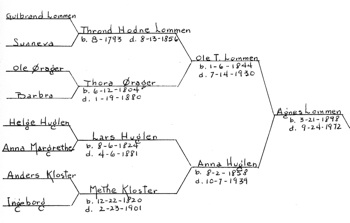
Ole T. wrote the following many years after settling in America :
“The name of the ship we came on was “Immanuel C. Sorensen”, Svanes Rederi. We landed at New York after six weeks and two days. Then went up the Hudson River to Troy, then west through the Erie Canal on a canal boat (pulled by horses walking on land) to Buffalo. From there we went across Lake Michigan to Milwaukee. From there with hired horse team to Koshkenong, Wisconsin. Here father bought a team of oxen and wagon and we started on to Iowa, where we arrived in September. We stayed all of that winter with Ole L. Bergan and family in their small log cabin. The cabin was well packed that winter. When all the rest had gone to bed, brother Gulbrand and Knut Bergan had to take their bedding and spread it on the floor to sleep on. Before I woke up in the morning they had gotten up and taken things away.”
Father (Thrond Lommen) bought some land southwest of Decorah where Aiken Spring is located. On it he built a stone cabin in the spring of 1852. He moved us there in April that year. Father had gotten a few bushels of wheat that he took to a mill. It was called Owens Mill. I believe it was at Auburn, 35 miles away. He was gone for three days. During that time we had no flour, but lived on milk. While he was gone a flood surrounded our home. Water came into the house. It started to come into my bed, and into a Norwegian chair. Father’s chest of books started to float around. Then mother took me on her back and carried me up the hill. We were all saved. Mother had taken along a box of matches to save it. I still remember the smell of the sulphur.
In 1852 father had seeded four acres of wheat. At that time there were no threshing machines around. Brother Gulbrand and Gullick Lien who also had a small stack of wheat, therefore had to try to thresh with oxen. They scraped the grass away and laid the bundles in a ring on the ground. Then they made six oxen walk around on it until the grain was threshed out. This I have literally seen, as Scripture says, “One binds not the mouth of the oxen which threshes.”
In those days there was timber covering practically all the land here. This was cut down and cleared away by the pioneers so they could plow and plant the ground. Oxen were used to pull vehicles and what they had of machinery. Prairie chickens were common. He told how they were so tame he was a little afraid of them. He told about a cat he had that used to follow him around on the farm, and one time it killed a snake. At the time of the Indian Scare when the Indians were massacring the white settlers in Minnesota and heading this way, word had gotten out that Calmar, then known as “Whiskey Grove” had been burned. Father and several other young men took horses (by this time they had horses) and rode horseback far enough so they could see it was not true. On the way back they stopped at a house where they found the owners had left in a hurry leaving supper on the table so they just sat down and ate. Many of the settlers around here too left their homes. But soldiers had been sent out and the Indians did not get this far south. Besides telling about those early days, Father used to tell us fairy stories and sing for us. He had a very good voice as well as good ear for music. He knew by heart most of the commonly used hymns of our church as well as many gospel hymns and the war songs popular during the Civil War. He wanted to enlist in Civil War, but his mother would not sign for him and he was not of age.